About this project
Avidya as a Physical Limit
IOF asks what changes when the measurement basis is no longer treated as an external knob, but as a finite physical reference variable generated inside the same world it measures.
Start with the Conceptual Overview if you want the idea in plain language, video, audio, slides, or formal text. Then move to the papers below.
The Ignorant Observer is the full framework. The foundational extensions sharpen the measurement-basis question and the conditional fixed-context Born-form module. It begins with a binary record and extends hierarchically to any one calibrated finite-outcome context; phase and cross-context composition remain host-side. The empirical papers build a calibrated instrument: where basis-tracking is stressed, the visibility loss is recoverable reference-frame physics that standard quantum mechanics already contains — expected, not a departure from it. Measured and subtracted, that observer-side loss lets a mesoscopic experiment ask whether an unrecoverable, mass-geometry floor remains beneath the world's definiteness — the signature of Penrose objective reduction, not of IOF against quantum mechanics.
Five doorways into one idea — how IOF interprets quantum randomness, and how the same observer-side limit reaches us. Read it, watch it, or listen; each is a complete introduction. Choose the one that fits how you think.
Explainers have been created by AI and may contain errors. The authoritative source remains the underlying papers.
Note of the Author

The Ignorant Observer

Foundational Extensions
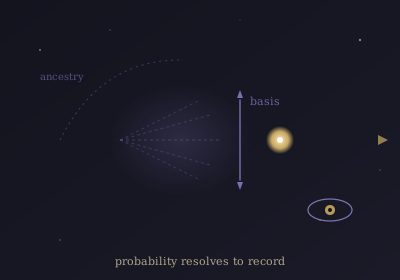
Where Did the Measurement Basis Come From?
Physics-facing entry point — reframes the measurement problem by asking why the basis is treated as if it came from outside physics. Best short introduction for physicists.
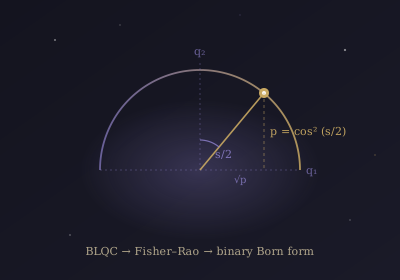
The Born Rule from Finite Observation
Conditional module — derives the binary Born weight and its hierarchical fixed-context extension from explicit finite-observer bridge assumptions.
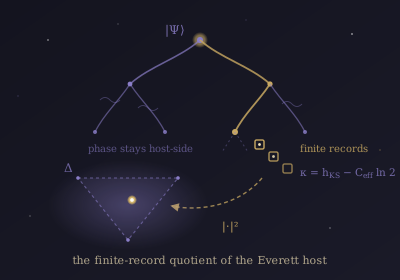
The Ignorant Observer inside Everett
Synthesis — reads the framework as the finite-record quotient of a no-collapse host, with Everett as the preferred (not exclusive) host. Assembles the four pillars, the Born split, the record-boundary probability closures, and the honest scope into one statement.
Empirical Test

Verification and Stress Checks
Can the analysis survive attack? General-phasor checks, bounded adversarial comparisons, conditional ROC/AUC calculations, and consistency stress tests.
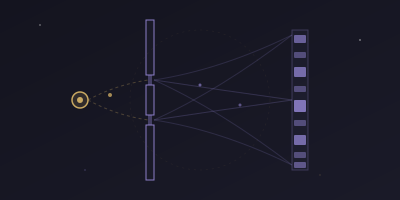
IOF Double-Slit Animation
Executable intuition — visualizes how finite basis tracking can suppress interference visibility, with auditable code.

Bandwidth-Limited Quantum Control
Operational core — when the projected instability of the tracked reference outruns independently calibrated useful, timely tracking capacity (κcal = hθ − η·Ceff ln 2 > 0), the raw record loses contrast by a calibrated factor. The complete estimator/controller chain is calibrated in Arm 0 and frozen before quantum outcomes; random delivery requires its own reliability rate. The full Kolmogorov–Sinai rate is used only when the projection is justified. This is recoverable reference-frame physics within standard quantum mechanics, not a departure from it.

A Capacity-Calibrated Protocol for Testing Penrose Objective Reduction
How to test it — calibrates the complete reference estimator/controller chain and projected hθ in electronics-only Arm 0, freezes Ceff and η before quantum outcomes, then varies Penrose mass geometry to discriminate an unrecoverable objective-reduction floor from recoverable reference loss.
Supplements
Forensic Signatures
Retrospective signal analysis under methodological reconstruction.

The Creation of Duality
Speculative extension — aims to become a theory of appearance: how space, time, objecthood, and gravity arise as artifacts of finite observation rather than fundamental features of the world.

The Capacity-Backaction Frontier
A standard-QEC rate coordinate for useful syndrome capacity and induced physical instability

Biological Observers
Biological tracking programme under experimental reconstruction.